
Species Profile | Images | Breeding Report | Similar Species
back to the livebearer index
How to look afterXiphophorus maculatus
Platy
(Guenther, 1866) 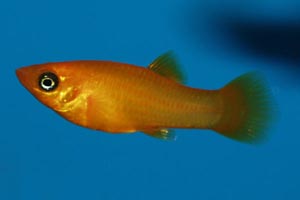
(Other members of the genus Xiphophorus)
ADULT SIZE: 6 cm
WATER CONDITIONS: Moderately hard and alkaline
TEMPERATURE RANGE: 21-25 C
FOOD: Feed Xiphophorus maculatus small live-foods and fine grade dried foods. Some vegetable component to the diet is welcomed.
DISTRIBUTION: This species comes from Belize, Guatemala, Honduras, Mexico
AQUARIUM CARE: The platy is an all-time aquarium favourite, with very many varieties and colour forms. It is very easy to keep and breed in slightly harder water. Males can be a little aggressive towards females, and in order to avoid over-stressing them it is a good idea to have 2-3 females for each male, and/or ample hiding places to allow the females some respite from the male’s attentions. If fry are to be raised this cover can also improve survival chances, giving them somewhere to escape predation from their parents and other fish.
Fry are produced every three weeks or so, and the females can actually store sperm to fertilize eggs even with no male present.
The Platy is an ideal community species; peaceful, hardy and easy to keep and breed. Platies will interbreed readily with swordtails (Xiphophorus helleri) but generally not other livebearers.
BREEDING: No special treatment is required to breed the platy, and they will give birth to offspring about every three weeks. They are livebearing fish (they give birth to fish, rather than lay eggs), and the fry are big enough to eat powdered flake food. They prefer, and grow more quickly on, newly hatched artemia nauplii. Heavily pregnant females can be placed in a breeding trap, or another small tank, and removed once she has given birth – other fish will eat young livebearer fry.
Have you bred Xiphophorus maculatus? Why not fill in a breeding questionaire?, or examine existing Xiphophorus maculatus breeding reports
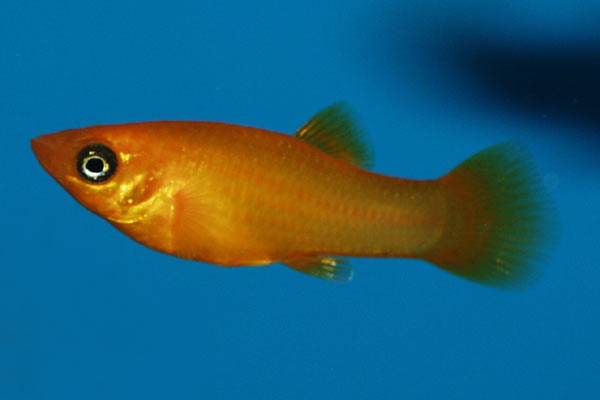
This orange platy is one of many colour forms, that are much brighter than the wild fish

A terrific black platy
BREEDING: No special treatment is required to breed the platy, and they will give birth to offspring about every three weeks. They are livebearing fish (they give birth to fish, rather than lay eggs), and the fry are big enough to eat powdered flake food. They prefer, and grow more quickly on, newly hatched artemia nauplii. Heavily pregnant females can be placed in a breeding trap, or another small tank, and removed once she has given birth – other fish will eat young livebearer fry.
Have you bred Xiphophorus maculatus? Why not fill in a breeding questionaire?
|
This page summarises breeding reports provided by visitors to this site, along with some statistical analysis. Please feel free to contribute – whatever your experience! 6 breeders have filled in breeding reports, a summary of the results are shown in the graphs below. You can read the full reports here. To add details of your experiences of Xiphophorus maculatus, why not fill in a Breeding and maintenance Report. |
|||||
|
|
|
||||
|
|
|
||||
|
|
|
||||
|
|
|
Remember, each record represents only one persons experience; if you had different results, or used different methods, please share your experiences
| Water conditions: Moderately hard and alkaline | Water temperature: 24-27oC |
| Disposition: Slightly timid | Community tank?: Yes, a good community fish |
| Spawning Method: Other (see below) | Breeding problems: Skewed sex ratio |
| Sex ratio: Almost all males | Breeding difficulty: Difficult |
| Sucess: Very unsucessful | Years Experience: 1 |
| Other Comments: | |
| Date this record created: 24th February 2013 | Breeding date: 2013 |
| Breeder: | Location: |
| Water conditions: | Water temperature: |
| Disposition: Active, but not aggresive | Community tank?: Yes, a good community fish |
| Spawning Method: Adult fish removed from tank | Breeding problems: Poor fry survival rate |
| Sex ratio: Somewhat male heavy | Breeding difficulty: Average |
| Sucess: Fairly unsucessful | Years Experience: 1 |
| Other Comments: This is a great fish for any one, they are fairly easy to maintain and if your intrested in breeding any type of fish I suggest giving these plattys the first go round. When I started breeding fish I could never tell if they were pregnant or not so I went out and found see thru fish. HAHA It makes the whole experiance a whole lot better watching them grow inside. I raise mickey mouse plattys and have had a blast. | |
| Date this record created: 3rd March 2009 | Breeding date: 2009 |
| Breeder: Adam | Location: Poland, Maine |
| Water conditions: Neutral | Water temperature: 24-27oC |
| Disposition: Active, but not aggresive | Community tank?: Yes, a good community fish |
| Spawning Method: Other (see below) | Breeding problems: none |
| Sex ratio: Roughly equal | Breeding difficulty: Very easy |
| Sucess: Fairly sucessful | Years Experience: 1 |
| Other Comments: | |
| Date this record created: 21st April 2008 | Breeding date: 2008 |
| Breeder: kitty bearer | Location: lu1 |
| Water conditions: Moderately hard and alkaline | Water temperature: 24-27oC |
| Disposition: Somewhat aggresive on occasions | Community tank?: Yes, a good community fish |
| Spawning Method: Long term (fry appear with adults) | Breeding problems: Poor fry survival rate |
| Sex ratio: | Breeding difficulty: Very easy |
| Sucess: Average | Years Experience: 1 |
| Other Comments: very easy, but before you know it, your tank has too many fish, and disease can set in. Best to distribute fry to other aquarists early on | |
| Date this record created: 6th February 2008 | Breeding date: 2000 |
| Breeder: lungfish | Location: |
| Water conditions: Moderately hard and alkaline | Water temperature: 24-27oC |
| Disposition: Active, but not aggresive | Community tank?: Yes, a good community fish |
| Spawning Method: Long term (fry appear with adults) | Breeding problems: none |
| Sex ratio: | Breeding difficulty: Very easy |
| Sucess: Very sucessful | Years Experience: 3 |
| Other Comments: Platys are no problem to breed. I was quickly overrun with platys I had no room for | |
| Date this record created: 13th January 2008 | Breeding date: 1995 |
| Breeder: | Location: |
| Water conditions: Moderately soft and acidic | Water temperature: 24-27oC |
| Disposition: Active, but not aggresive | Community tank?: Only with species of similar size |
| Spawning Method: Long term (fry appear with adults) | Breeding problems: Poor fry survival rate |
| Sex ratio: Roughly equal | Breeding difficulty: Average |
| Sucess: Fairly sucessful | Years Experience: 1 |
| Other Comments: | |
| Date this record created: 13th January 2008 | Breeding date: 2008 |
| Breeder: | Location: |