
Species Profile | Images | Breeding Report | Similar Species
back to the catfish index
How to look afterScleromystax barbatus
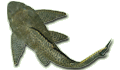
Bearded catfish, Banded cory, Giant cory
Quoy & Gaimard, 1824
(Other members of the genus Scleromystax)
ADULT SIZE: 10 cm
WATER CONDITIONS: Not critical
TEMPERATURE RANGE: 20-25 C
FOOD: Feed Scleromystax barbatus live and dried foods
DISTRIBUTION: This species comes from Brazil
AQUARIUM CARE: This larger cory-type cat can reach sizes of almost four inches. Although often referred to as Corydoras barbatus, it has recently been moved to the genus Scleromystax. Best kept in a shoal of at least six individuals. An ideal tank will have a fine substrate, and slightly cooler, well-oxygenated water.
BREEDING: Like many other similar catfish species, spawning in S. barbatus can be induced by heavy feeding of livefoods, followed by large water changes of cooler water.
Have you bred Scleromystax barbatus? Why not fill in a breeding questionaire?, or examine existing Scleromystax barbatus breeding reports
BREEDING: Like many other similar catfish species, spawning in S. barbatus can be induced by heavy feeding of livefoods, followed by large water changes of cooler water.
Have you bred Scleromystax barbatus? Why not fill in a breeding questionaire?
|
This page summarises breeding reports provided by visitors to this site, along with some statistical analysis. Please feel free to contribute – whatever your experience! 1 breeder has filled in a breeding report, a summary of which is shown in the graphs below. You can read the full reports here. To add details of your experiences of Scleromystax barbatus, why not fill in a Breeding and maintenance Report. |
|||||
|
|
|
||||
|
|
|
||||
|
|
|
||||
|
|
|
Remember, each record represents only one persons experience; if you had different results, or used different methods, please share your experiences
| Water conditions: Moderately hard and alkaline | Water temperature: 20-23oC |
| Disposition: Very timid | Community tank?: Only with species of similar size |
| Spawning Method: Other (see below) | Breeding problems: Poor fry survival rate |
| Sex ratio: Roughly equal | Breeding difficulty: Very easy |
| Sucess: Fairly sucessful | Years Experience: 1 |
| Other Comments: Make sure you feed them (the parents) a variety of foods, they love sinking pellets but need some live foods (freezer) as well. When the eggs are laid the parents wont touch them but other fish will so remove them. After a month you will see a a growth change, fry will be about 1 inch. After approx 5 days they hatch, and another 2/3 days to eat the egg sack. Then you should start feeding them baby food. After about a month you can start feeding them ‘real’ food. I just had around 30 eggs hatch today! | |
| Date this record created: 18th June 2011 | Breeding date: 2011 |
| Breeder: S | Location: the Netherlands |