
Species Profile | Images | Breeding Report | Similar Species
back to the livebearer index
How to look afterPoecilia sphenops
Molly, Short-Finned Molly, Black Molly, Liberty Molly
Valenciennes, 1846 
(Other members of the genus Poecilia)
ADULT SIZE: 10 cm
WATER CONDITIONS: Not critical
TEMPERATURE RANGE: 18-28 C
FOOD: Feed Poecilia sphenops anything, a true omnivore. Although they will eat most foods, and readily accept flake, they do require a vegetable component to their diet; leave some algae in their tank on which they can graze.
DISTRIBUTION: This species comes from Belize, Guyana, Mexico
AQUARIUM CARE: The Molly, like other members of the Poecilia genus, are well known in aquarist circles, with very many colour strains available. They are not as easily maintained as some other livebearers, and although widely available, should perhaps be avoided by the new aquarist.
Their natural habitat is in fresh and sometimes brackish waters in Central America; adding a small amount of salt to their tank is possible, but certainly not necessary.
They are a very hardy species, perhaps a little more aggressive than similar species such as the Platy, but in general make great community tank subjects.
BREEDING: Mollies, like other widely available livebearers, are very easily bred, with tens or hundreds of fry produced every few weeks. Adults will eat fry, and although some will always survive, adults (or fry) can be removed to increase survival rates.
Have you bred Poecilia sphenops? Why not fill in a breeding questionaire?, or examine existing Poecilia sphenops breeding reports

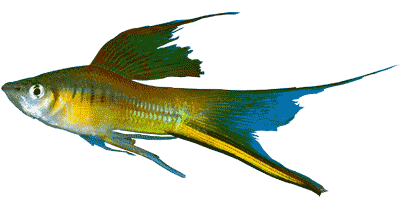
Mollies exist in very many colour forms

The attractive glowlight marble molly is basically yellow, with a white belly, and varying degrees of black speckling
BREEDING: Mollies, like other widely available livebearers, are very easily bred, with tens or hundreds of fry produced every few weeks. Adults will eat fry, and although some will always survive, adults (or fry) can be removed to increase survival rates.
Have you bred Poecilia sphenops? Why not fill in a breeding questionaire?
|
This page summarises breeding reports provided by visitors to this site, along with some statistical analysis. Please feel free to contribute – whatever your experience! 1 breeder has filled in a breeding report, a summary of which is shown in the graphs below. You can read the full reports here. To add details of your experiences of Poecilia sphenops, why not fill in a Breeding and maintenance Report. |
|||||
|
|
|
||||
|
|
|
||||
|
|
|||||
|
|
|
Remember, each record represents only one persons experience; if you had different results, or used different methods, please share your experiences
| Water conditions: Moderately hard and alkaline | Water temperature: 24-27oC |
| Disposition: Somewhat aggresive on occasions | Community tank?: Yes, a good community fish |
| Spawning Method: Long term (fry appear with adults) | Breeding problems: Poor fry survival rate |
| Sex ratio: | Breeding difficulty: Easy |
| Sucess: Fairly sucessful | Years Experience: 5 |
| Other Comments: We have a pair in our community tank – fry appear with some regularity, but quite a few disappear – maybe eaten by other fish? Not a big problem, I guess the toughest/fastest survive! | |
| Date this record created: 1st May 2016 | Breeding date: 2016 |
| Breeder: | Location: Lancashire, UK |