
Species Profile | Images | Breeding Report | Similar Species
back to the killifish index
How to look afterNothobranchius furzeri
Furzers Notho
Jubb 1971 
(Other members of the genus Nothobranchius)
ADULT SIZE: 8 cm
WATER CONDITIONS: Not critical
TEMPERATURE RANGE: 25-30 C
FOOD: Feed Nothobranchius furzeri predominantly live foods
DISTRIBUTION: This species comes from Zimbabwe, Mozambique
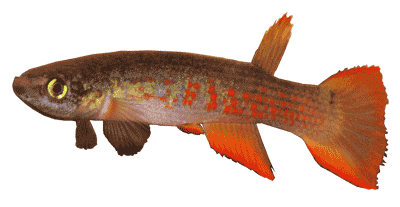
SEXUAL DIFFERENCES: Male Nothos are larger and far more colourful than the drab females.
AQUARIUM CARE: Nothobranchius furzeri is a truly remarkable species. It is the shortest living vertebrate (4-8 months usually) and can survive some of the most inhospitable regions on earthIt is an annual fish – relying on annula rainfall, and has evolved to hatch, breed and die within one season in some of the most unpredictable climates.
Wild fish live on mosquito larvae that are also growing up in the ponds left by seasonal rainfall. In the aquarium they can be quite aggressive unless raised as a group
BREEDING: Breeding of N. furzeri is not difficult. This is a typical annual substrate spawner, which should be spawned over peat, which is then partially dried and stored. Eggs develop at different rates, and this where the problems occur. Some will be ready to hatch after 2 weeks, some after 6 months of storage and others anywhere between. Sucessful long term maintenance of this species requires careful observation of the eggs, to follow their development
Have you bred Nothobranchius furzeri? Why not fill in a breeding questionaire?, or examine existing Nothobranchius furzeri breeding reports
LINKS:
killi.co.uk
fishbase

Nothobranchius furzeri is one of the shortest lived vertebrates
BREEDING: Breeding of N. furzeri is not difficult. This is a typical annual substrate spawner, which should be spawned over peat, which is then partially dried and stored. Eggs develop at different rates, and this where the problems occur. Some will be ready to hatch after 2 weeks, some after 6 months of storage and others anywhere between. Sucessful long term maintenance of this species requires careful observation of the eggs, to follow their development
Have you bred Nothobranchius furzeri? Why not fill in a breeding questionaire?
|
This page summarises breeding reports provided by visitors to this site, along with some statistical analysis. Please feel free to contribute – whatever your experience! 1 breeder has filled in a breeding report, a summary of which is shown in the graphs below. You can read the full reports here. To add details of your experiences of Nothobranchius furzeri, why not fill in a Breeding and maintenance Report. |
|||||
|
|
|
||||
|
|
|
||||
|
|
|
||||
|
|
|
Remember, each record represents only one persons experience; if you had different results, or used different methods, please share your experiences
| Water conditions: Neutral | Water temperature: 24-27oC |
| Disposition: Somewhat aggresive on occasions | Community tank?: Doubtful, only with VERY calm fish |
| Spawning Method: Peat (or similar) spawning substrate | Breeding problems: Poor fry survival rate |
| Sex ratio: Roughly equal | Breeding difficulty: Difficult |
| Sucess: Fairly sucessful | Years Experience: 5 |
| Other Comments: Keeping enough food available at the right size for these fish is hard. The fry don’t really want dried food, and if you don’t provide enough worms/artemia and so on, they will just eat each other. | |
| Date this record created: 23rd July 2008 | Breeding date: 2008 |
| Breeder: | Location: |