
Species Profile | Images | Breeding Report | Similar Species
back to the cichlid index
How to look afterGeophagus Steindachneri
Red Humped Eartheater
Eigenmann & Hildebrandt, 1910 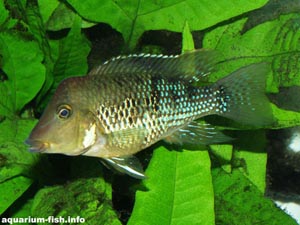
(Other members of the genus Geophagus)
ADULT SIZE: 20 cm
WATER CONDITIONS: Moderately soft and acidic
TEMPERATURE RANGE: 24-28 C
FOOD: Feed Geophagus Steindachneri live and dried foods
DISTRIBUTION: This species comes from Colombia
AQUARIUM CARE: A fairly peaceful burrowing species, that sifts through the substrate looking for food. Males have a distinct bump on their heads.
A Larger tank is preferred, as this species can grow quite large. Ideally an aquarium set-up would include a few inches of sand or fine gravel, with numerous rocks, and very good filtration. Continual earth shifting is a messy business.
BREEDING: Males can be aggressive at times, especially during spawning, so it is wise to keep 2-3 females with a male. They are typical polygamous cichlids; one male maintains several females. As soon as the eggs are laid, they are taken up by the female. She is a mouth brooder, and the male plays no further part. Females with young and eggs are more aggressive than at other times, and are probably best left with no tankmates. The fry will be released after about 3 weeks of care in the safety of the mothers mouth.
Have you bred Geophagus Steindachneri? Why not fill in a breeding questionaire?, or examine existing Geophagus Steindachneri breeding reports

Notice the orange patches in the corner of its mouth; an attempt to mimic eggs during spawning.
BREEDING: Males can be aggressive at times, especially during spawning, so it is wise to keep 2-3 females with a male. They are typical polygamous cichlids; one male maintains several females. As soon as the eggs are laid, they are taken up by the female. She is a mouth brooder, and the male plays no further part. Females with young and eggs are more aggressive than at other times, and are probably best left with no tankmates. The fry will be released after about 3 weeks of care in the safety of the mothers mouth.
Have you bred Geophagus Steindachneri? Why not fill in a breeding questionaire?
|
This page summarises breeding reports provided by visitors to this site, along with some statistical analysis. Please feel free to contribute – whatever your experience! 1 breeder has filled in a breeding report, a summary of which is shown in the graphs below. You can read the full reports here. To add details of your experiences of Geophagus Steindachneri, why not fill in a Breeding and maintenance Report. |
|||||
|
|
|
||||
|
|
|
||||
|
|
|||||
|
|
|
Remember, each record represents only one persons experience; if you had different results, or used different methods, please share your experiences
| Water conditions: Neutral | Water temperature: 24-27oC |
| Disposition: Somewhat aggresive on occasions | Community tank?: Yes, a good community fish |
| Spawning Method: Adult fish removed from tank | Breeding problems: none |
| Sex ratio: Almost all females | Breeding difficulty: Very easy |
| Sucess: Very sucessful | Years Experience: 1 |
| Other Comments: I had these Geos in a commuity 125 gallon tank. I noticed one female carrying, so I pulled the pair and moved them into a 40 gallon breeder tank. After about 3 weeks, I noticed about 20 fry. Within two days, I was down to 3 fry. About a month later, I noticed her not eating again, and figured she was holding. I was correct. About 3 weeks later, I noticed around 30 fry swimming under some rock formations. I sat back and watched the parents suck them out from under the rocks. I figured they were just protecting them, but they were actually eating them. The third time around; I waited 2 1/2 weeks, then netted the female out. When I netted her, she spit out most of the fry. I got to to spit out the rest, then I placed them back into the breeding tank WITHOUT the parents. All 46 fry are still alive one month later. The conclusion I reached, was to pull the parents, stirp the female of the fry, and put the fry back into the breeding tank. I am running a power head in the tank, with a sponge filter. The water temp is around 80 degrees. PH stays around 6.8 – 7.1 | |
| Date this record created: 2nd January 2009 | Breeding date: 2008 |
| Breeder: [email protected] | Location: USA |