
Species Profile | Images | Breeding Report | Similar Species
back to the labyrinth index
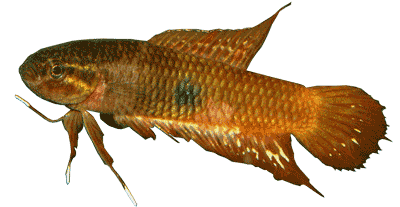
How to look afterBetta splendens
Siamese fighting fish
Regan, 1910
(Other members of the genus Betta)
ADULT SIZE: 6 cm
WATER CONDITIONS: Not critical
TEMPERATURE RANGE: 23-28 C
FOOD: Feed Betta splendens live and dried foods
DISTRIBUTION: This species comes from Thailand
AQUARIUM CARE: The Siamese fighting fish is an aquarium favourite, worldwide; yet it was one of the first species to be commercially sold. It originates from still waters around the Metang river in Thailand, but is now widespread in south east Asia, and even parts of Southern America.The Siamese fighting fish lives up to its name – males will fight to the death (which was a desireable characteristic in the past) and nowadays they are often kept in Betta jars, especially in shops. Males will also attack other species that are similar enough to it.
The females are less aggressive, however at spawning time will eat each others fry and eggs.
BREEDING: Spawning occurs and eggs are deposited in a bubble nest, typical of anabantids. The nest can be scooped out and the fry raised seperately from their parents. The fry take artemia and dried foods.
Have you bred Betta splendens? Why not fill in a breeding questionaire?, or examine existing Betta splendens breeding reports
BREEDING: Spawning occurs and eggs are deposited in a bubble nest, typical of anabantids. The nest can be scooped out and the fry raised seperately from their parents. The fry take artemia and dried foods.
Have you bred Betta splendens? Why not fill in a breeding questionaire?
|
This page summarises breeding reports provided by visitors to this site, along with some statistical analysis. Please feel free to contribute – whatever your experience! 4 breeders have filled in breeding reports, a summary of the results are shown in the graphs below. You can read the full reports here. To add details of your experiences of Betta splendens, why not fill in a Breeding and maintenance Report. |
|||||
|
|
|
||||
|
|
|
||||
|
|
|
||||
|
|
|
Remember, each record represents only one persons experience; if you had different results, or used different methods, please share your experiences
| Water conditions: Neutral | Water temperature: 20-23oC |
| Disposition: Very aggressive | Community tank?: Never |
| Spawning Method: Adult fish removed from tank | Breeding problems: none |
| Sex ratio: | Breeding difficulty: Average |
| Sucess: | Years Experience: 1 |
| Other Comments: | |
| Date this record created: 29th December 2009 | Breeding date: 2009 |
| Breeder: | Location: |
| Water conditions: Moderately hard and alkaline | Water temperature: 24-27oC |
| Disposition: Very aggressive | Community tank?: Yes, a good community fish |
| Spawning Method: Adult fish removed from tank | Breeding problems: none |
| Sex ratio: Roughly equal | Breeding difficulty: Difficult |
| Sucess: Average | Years Experience: 30 |
| Other Comments: The hardest parts are as follows; 1) a ready female, if not she will be damaged and not breed. 2) Maintain a constant temperature (80-82F) 3) remove female when breeding done, male will attack her and may destroy nest. 4) remove male when fry are free swimming, he will eat them. 5) Very important, feed well, RINSE brine shrimp before feeding. Excess salt will stunt growth of fry. Keep tank clean and surface free of film. 6) Keep best females for further breeding stock | |
| Date this record created: 28th January 2009 | Breeding date: 2009 |
| Breeder: | Location: |
| Water conditions: Neutral | Water temperature: 24-27oC |
| Disposition: Very aggressive | Community tank?: Yes, a good community fish |
| Spawning Method: Adult fish removed from tank | Breeding problems: Poor fry survival rate |
| Sex ratio: Roughly equal | Breeding difficulty: Difficult |
| Sucess: Fairly unsucessful | Years Experience: 2 |
| Other Comments: I hav two fighting fis a simese one and a crowntail the male and female siames spawned and one fry survived because i haven’t notice that the eggs turned to frythat’s why, the male has eaten all the fries except one….. IN my crowntail, many survived but they all died because of pneumonia.. | |
| Date this record created: 7th September 2008 | Breeding date: 2008 |
| Breeder: john mark | Location: imus, cavite, philippines |
| Water conditions: Neutral | Water temperature: 16-19oC |
| Disposition: Slightly timid | Community tank?: Never |
| Spawning Method: Spawning Mops | Breeding problems: Poor egg production |
| Sex ratio: Roughly equal | Breeding difficulty: Average |
| Sucess: Average | Years Experience: 3 |
| Other Comments: | |
| Date this record created: 8th January 2008 | Breeding date: 2002 |
| Breeder: cool_78 | Location: Philippines |